SKU: 80922883803
peace lily potting soil mix

peace lily potting soil mix Peace Lily Potting Soil

Sale price$24.12 Regular price$26.80
Save 10%

Pay in installments of $6.70 with ShopPay, AfterPay and Klarna

Shipping Estimate
USA
  • USA
  • CAN

Ships within 48 hours · Estimated delivery Jul 23 - Jul 28

Promo Codes Available:

For Your Every Summer RSVP, with Code: SUMMER15

Description

peace lily potting soil mix Peace Lily Potting SoilKeep Your Peace Lily Thriving with the Right Soil Give your peace lily the perfect growing environment with our premium Peace Lily Soil, a specially formulated blend that balances moisture retention with excellent drainage. Unlike ordinary mixes, this potting soil for peace lily is designed to meet adequate peace lily soil requirements, preventing root rot while encouraging vibrant green leaves and long lasting white blooms. How to Repot Peace Lily

Keep Your Peace Lily Thriving with the Right Soil 

Give your peace lily the perfect growing environment with our premium Peace Lily Soil, a specially formulated blend that balances moisture retention with excellent drainage. Unlike ordinary mixes, this potting soil for peace lily is designed to meet adequate peace lily soil requirements, preventing root rot while encouraging vibrant green leaves and long-lasting white blooms.

How to Repot Peace Lily Plants

Repotting is simple with the right peace lily repotting soil. Gently remove your plant from its container, loosen the root ball, and trim away any dead roots. Place in a slightly larger pot, then fill in with our nutrient-rich peace lily soil mixture. Water well and return to a bright, indirect light location for best results.

When to Repot a Peace Lily Plant

Peace lilies should be repotted every 1–2 years or whenever roots begin to crowd the pot. Fresh peace lily soil mix provides better aeration, replenished nutrients, and the ideal loamy texture for new growth. Spring is the best time to refresh your peace lily for healthier roots and more blooms.

Ingredients in Our Peace Lily Soil Mix Recipe

This chunky, loamy mixture is the best soil for peace lily, providing both aeration and water retention to prevent overwatering issues.

  • Composted Pine Bark  –  Improves airflow and supports strong root systems

  • Peat MossRetains the perfect amount of moisture while creating a slightly acidic environment

  • PerliteEnhances drainage and prevents compaction

  • Coconut CoirEco-friendly fiber that supports root strength and consistent hydration

  • Granite Sand – Adds grit for drainage and soil stability

  • Dolomite Lime – Balances pH and adds calcium & magnesium for overall plant health

Why Gardeners Love Our Peace Lily Soil

  • Well-Draining Yet Moisture-Retentive – Prevents root rot while keeping soil evenly hydrated

  • Encourages Vibrant Blooms – Nourishes healthy foliage and signature white flowers

  • Perfect for Semi-Aquatic Houseplants – Works beautifully for peace lilies and other tropicals

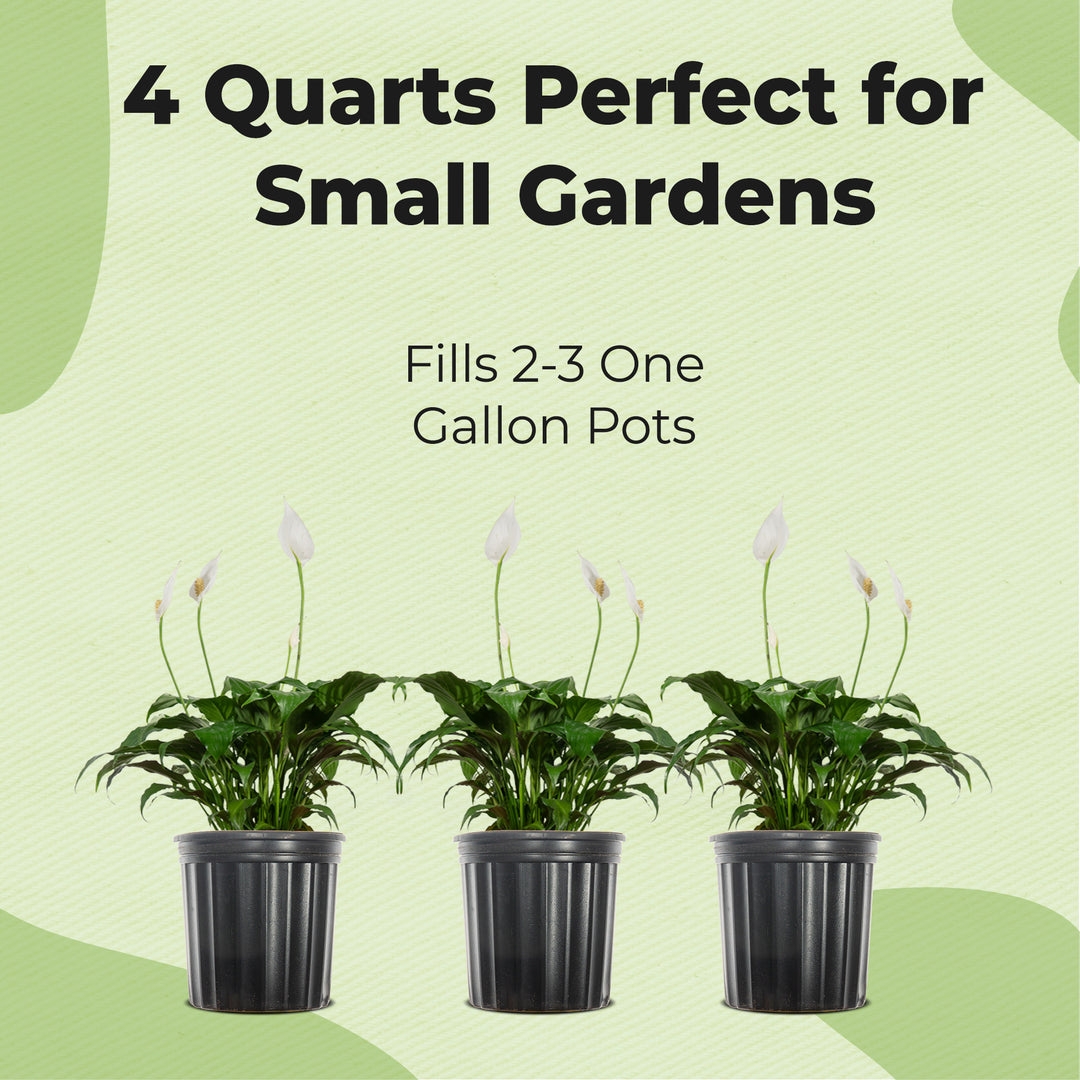
  • Convenient Sizes – Available in 4 qt. and 8 qt. resealable bags for easy indoor repotting

  • Hand-Mixed in the USA – Over 40 years of horticultural expertise in every bag

With our premium Peace Lily Soil, you’ll have the perfect foundation for lush growth and thriving blooms—keeping your peace lily happy, healthy, and beautiful season after season.

Happy planting!

Shipping Notes
  • Free Standard Shipping on $100+ Orders to the USA.
  • Except Preorder products are shipped in 48 hours.
  • Delivery to the USA:
  1. Standard Shipping : 3-10 business days
  • If time is of the essence, please consider selecting expedited delivery for faster service.
Exchange/Return Notes
  • We offer a 30-day return/exchange service after receiving.
  • Final sale items are not eligible for returns or exchanges.
  • To process your return/exchange, please contact us at [email protected]
  • Please click here for more details>>> Return & Exchange Policy
SKU: 80922883803

Discover Niche Categories That Outsell peace lily potting soil mix

Top-Converting Item to Boost Your Average Order

4.8 ★★★★★
Based on 6 reviews
Sort
Highest Rating
Newest First
Oldest First
Product Reviews
A
Verified Purchase
Amazon Customer
Waukegan, US
★★★★★ 5
Five Stars
Format: Paperback
Excellent
WAS THIS REVIEW HELPFUL?YesReportShare
Reviewed in the United States on April 10, 2015
C
Verified Purchase
Cuddles the Bichon
Carnegie, US
★★★★★ 2
I feel as though they simplified a lot of the ...
Format: Paperback
I feel as though they simplified a lot of the information, as common sense could tell you things such as time commitment to law school and to work with your professors in the case of an emergency
WAS THIS REVIEW HELPFUL?YesReportShare
Reviewed in the United States on July 21, 2017
L
Verified Purchase
LUV 2 Read
Belleville, US
★★★★★ 5
a nice simple history of the American flag
Format: Hardcover
This book is a history of the American flag. It has good illustrations, good print with 3 to 5 sentences per page. A page at the back show appropriate handling and uses.
WAS THIS REVIEW HELPFUL?YesReportShare
Reviewed in the United States on April 8, 2026
A
Verified Purchase
Allen G.
Draper, US
★★★★★ 5
Good choice to teach kids to be well-mannered at Memorial Day.
Format: Hardcover
The book starts with the 13 colonies each with their own flag. Then it discusses the Revolutionary war and the story of Betsy Ross with the qualifier that It says no one really knows who sewed the first flag. Then it discusses Francis Scott Key and the bombardment of Fort McHenry. Then how a star is added for each state added to the union. Mentions the Civil War and raising the flag on Iwo Jima. After that it has two pages on protocol for displaying and honoring the flag, and gives the pledge of allegiance. It is a good choice to teach kids to be well-mannered at parades and Memorial Day services. The cover art depicts a series of historical flags, not all of which are mentioned in the book which raises the question “Why?”. Starting at the back is the red Saint George’s Cross on a white field. Saint George the dragon slayer is the patron saint of England. The plain cross without the centered crown is the flag of England. This flag is shown on page 2 as the flag of one of the colonies but it doesn’t say which. In front of that is the flag of Maryland Colony which is still used as their state flag. Next in line is the coiled rattle snake Don’t Tread on Me flag. According to my Compton’s Encyclopedia, this originated with Esek Hopkins the first US Navy commander in chief and was used from 1776 to 1778. Colonel Christopher Gadsden presented a copy of this flag to the South Carolina legislature, so it is often referred to as the Gadsden flag but this is incorrect. The rattle snake image was used in 1775 by the minute men of Culpepper County Virginia. The image was widespread in the revolution and may have been used earlier than that. The snake is portrayed with 13 rattles, one for each colony. Rattle snakes will not initiate an attack on humans as we are too big to eat, but if stepped on they will counter attack and can be deadly. The point of the image is that the colonists did not want war, but would not tolerate abuse. (There is a rumor that this flag is connected to the slave trade, but Hopkins was from Rhode Island which was not part of the Confederacy, and I have not found any evidence to support this rumor). Next is the flag of New England which has the Saint George cross with a Pine Tree on a blue field. This flag was used at the battle of Bunker Hill. Normally the New England flag has a red field, but blue was substituted because the red caused confusion with the British Royal Navy ensign which has a Union Jack in the top left on a red field. Naval ensigns are designed to be highly visible at distance or in the smoke of battle. The bright red field is more visible than the Union Jack alone. The Union Jack is the national flag of the United Kingdom. Next is the Union Jack on a field of thirteen stripes. This is the first flag of the thirteen colonies. It was used in 1775 and 1776 as the flag of the continental army and navy but never officially adopted. Next is the Betsy Ross flag, followed by the Fort McHenry flag, and the modern flag. I hope this helps.
WAS THIS REVIEW HELPFUL?YesReportShare
Reviewed in the United States on September 4, 2023
S
Verified Purchase
SweetT
Omaha, US
★★★★★ 5
No progressive agenda! Perfect kids book!
Format: Hardcover
I'm a homeschooling parent of a kindergartener. As part of our social studies curriculum, I have been introducing the Pledge of Allegiance and the anthem, and I wanted to find a book that would go a little further into how the flag came to be and why we stand to say the Pledge, and this was the perfect book! It's written with great accuracy and at a child's level. There is also no progressive agenda, as I had discovered with some of the other kids books on the subject. It also lists when and how you are to stand for the flag, and has the Pledge printed in it. Would definitely recommend!
WAS THIS REVIEW HELPFUL?YesReportShare
Reviewed in the United States on September 27, 2025

recommand products